Language
- English
- Español
- Português
- русский
- Français
- 日本語
- Deutsch
- tiếng Việt
- Italiano
- Nederlands
- ภาษาไทย
- Polski
- 한국어
- Svenska
- magyar
- Malay
- বাংলা ভাষার
- Dansk
- Suomi
- हिन्दी
- Pilipino
- Türkçe
- Gaeilge
- العربية
- Indonesia
- Norsk
- تمل
- český
- ελληνικά
- український
- Javanese
- فارسی
- தமிழ்
- తెలుగు
- नेपाली
- Burmese
- български
- ລາວ
- Latine
- Қазақша
- Euskal
- Azərbaycan
- Slovenský jazyk
- Македонски
- Lietuvos
- Eesti Keel
- Română
- Slovenski
- मराठी
- Srpski језик
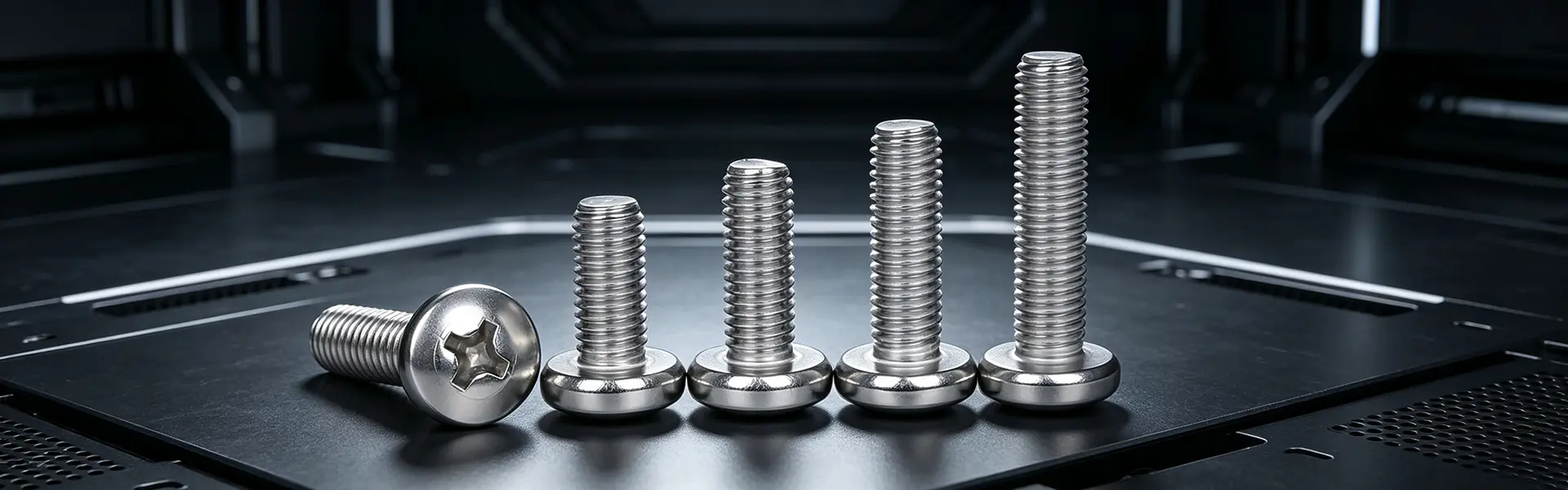

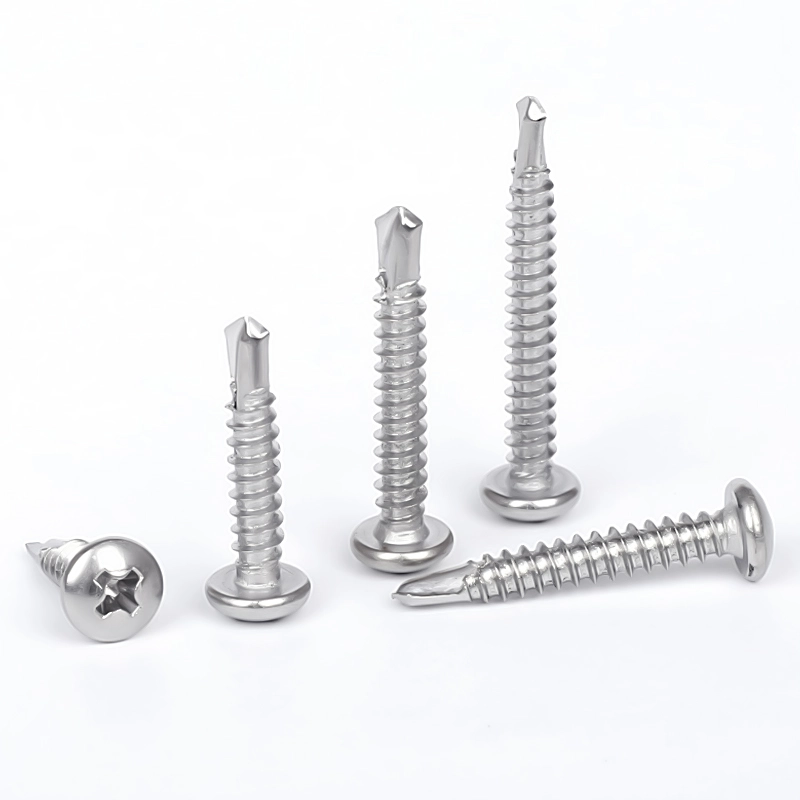
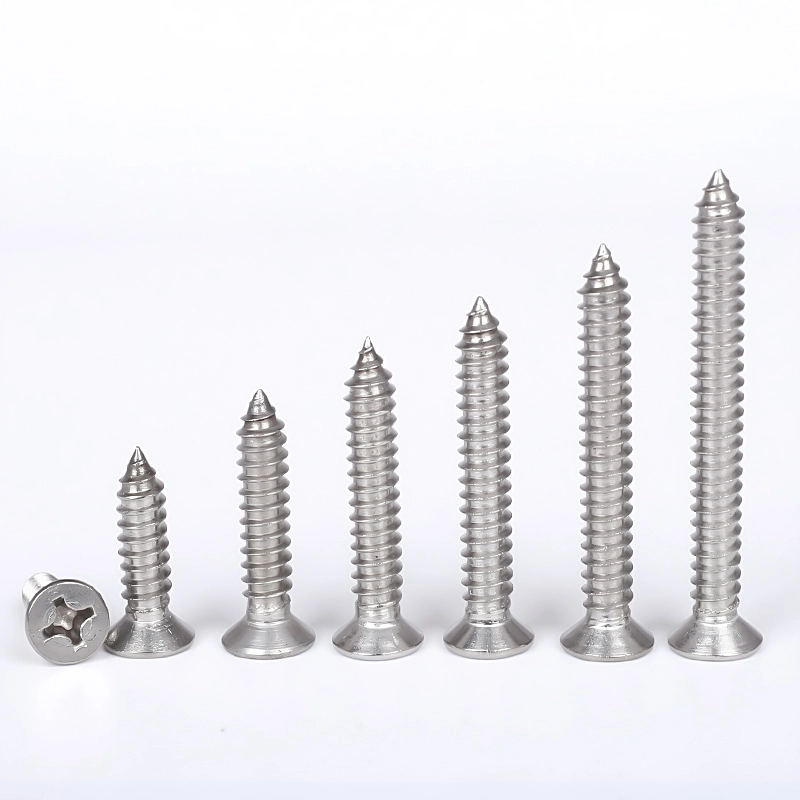
DIN 7504M Countersunk Head Self-Drilling Screw
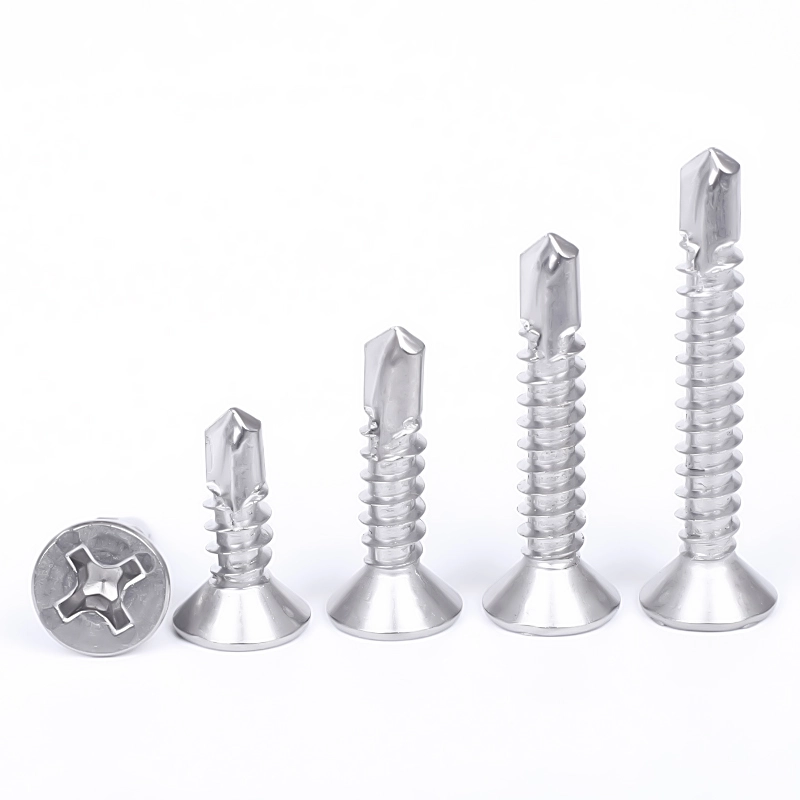
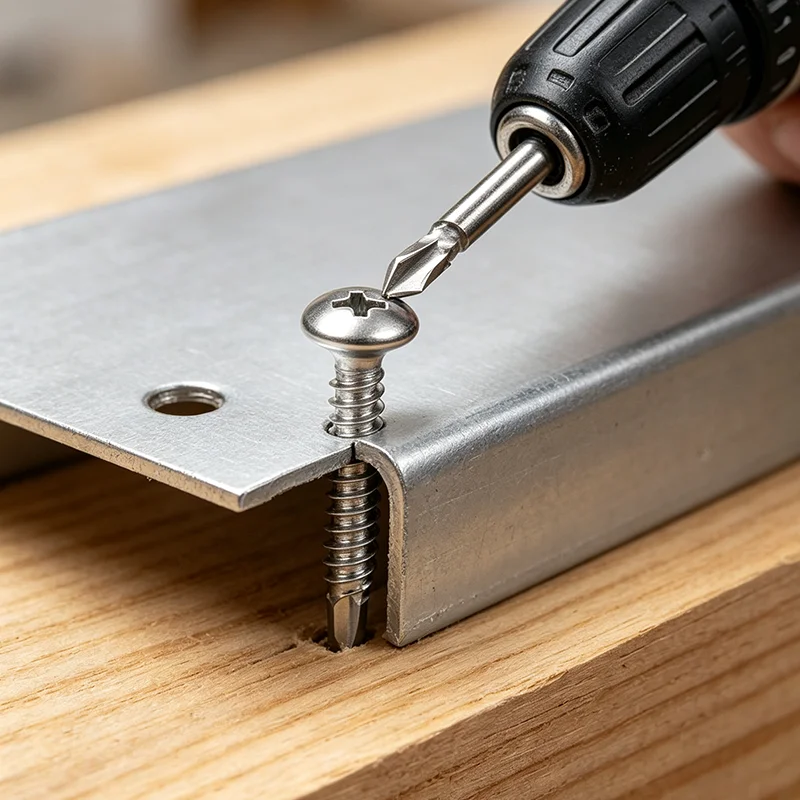
The DIN 7504M Countersunk Head Self-Drilling Screw supplied by Wanluo Factory is an integrated fastening component specifically designed for precise assembly of metal sheets and profiles under the German standard system. It features both concealed flat installation and efficient drilling and locking performance. Unlike the DIN7504K round-head exposed self-drilling screw, this product adopts a 90° standard conical head structure, integrating drilling, tapping, and locking functions. There is no need for pre-drilling or pre-treatment of the threads. The metal substrate can be fixed and assembled in a single operation.
The DIN 7504M Countersunk Head Self-Drilling Screw directly sold by Wanluo manufacturer fundamentally resolves the assembly defects such as structural interference, surface unevenness, friction and collision caused by exposed screws. Meanwhile, it retains the powerful penetration advantage of the high-hardness drill tail. Relying on the integrated cold forging and overall heat treatment process, the finished product has high hardness, stable drilling, and firm locking, and takes into account the assembly accuracy, appearance flatness and structural reliability. It is a dedicated fastening solution for precision equipment, streamlined metal structures and high-end engineering installations.
Core selling points
1. Self-drilling with flush head assembly, zero interference installation
Our DIN 7504M Countersunk Head Self-Drilling Screw adopts the national standard 90° taper head design. After completion, the screw is fully sunk into the workpiece's sink hole, with a smooth surface without protrusions. This completely avoids problems such as component scraping, movement interference, and structural collision caused by protruding screws. It is suitable for assembly scenarios with high standards for surface flatness and structural compactness.
2. Integrated self-drilling structure, significantly improves efficiency and reduces costs
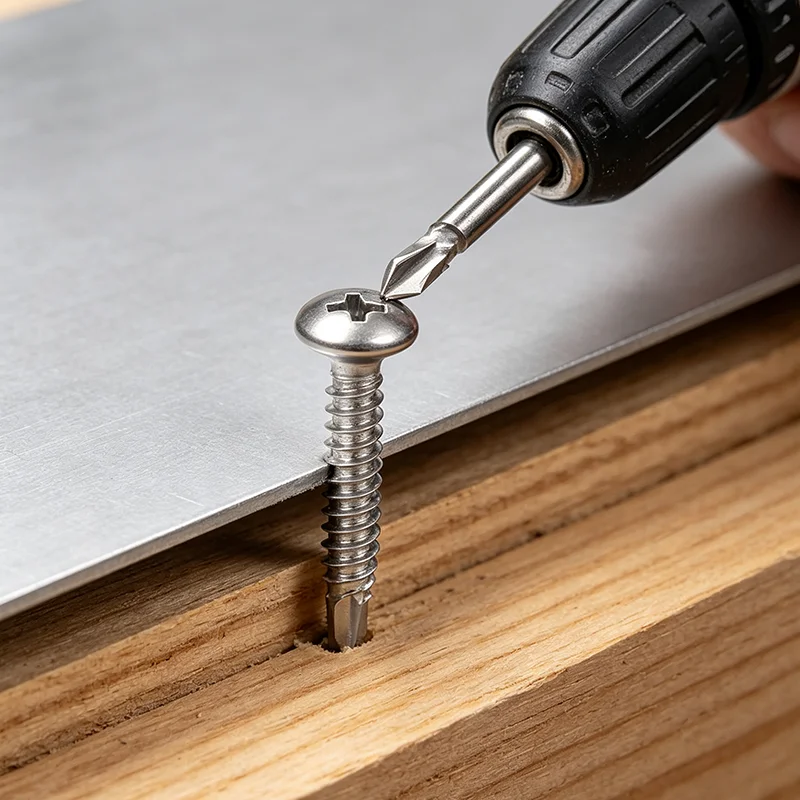
Equipped with a precise triangular drill tail, it does not require pre-drilling or pre-tapping. It can directly penetrate steel plates, aluminum profiles, and composite metal sheets, completing the drilling, threading, and locking processes in one step. This simplifies the construction process and reduces equipment and labor input, suitable for batch industrial assembly.
3. Heat-treated reinforced material, stable drilling without deformation
The entire screw is processed through high-temperature heat treatment, with uniform hardness improvement. The drill tail edge is sharp, wear-resistant, and less likely to chip or bend. During high-speed drilling, there will be no problems such as board warping, hole position deviation, or screw breakage. The construction stability of thick metal sheets is extremely strong.
4. Standard cross-slot design, no slipping or slot collapse during construction
The cross-slot is formed neatly and has a standard depth, which is highly compatible with manual screwdrivers, electric screwdrivers, and pneumatic tools. During high-speed locking and high-load drilling, the force is evenly distributed, effectively avoiding tool slipping, slot wear, and collapse. The durability and construction tolerance are higher.
5. Dense tooth engagement structure, long-term seismic resistance and anti-loosening
The screw thread arrangement is dense and uniform, with full tooth shape. The contact area with the metal substrate is large, and the gripping force is strong. Under long-term vibration and repeated force application of equipment, it can still maintain a tight locking state, and is less likely to experience loosening, detachment, or connection failure.
6. Corrosion-resistant and weather-resistant, suitable for complex working conditions
Using high-quality stainless steel material and fine surface treatment, it has excellent anti-corrosion and anti-oxidation performance. It can be used stably for indoor precision assembly, outdoor projects, and humid conditions. It is unlikely to rust or become stuck over a long period of use, and has a much longer service life than ordinary self-drilling screws.
Application scenario
1. Precision sheet metal equipment assembly
2. Streamlined metal structure engineering
3. Outdoor steel structure lightweight erection
4. Assembly of instrument and equipment shells
Product Parameter
|
Parameter Item |
Detailed Specification |
|
Product Name |
Stainless Steel DIN 7504 M Countersunk Head Self-Drilling Screw, Flat Head Drill Tail Screw |
|
Executive Standard |
DIN 7504 M, ISO Standard, GB Standard, Custom Non-standard Sizes |
|
Available Material |
304 Stainless Steel, 410 Stainless Steel, High-strength Zinc-plated Carbon Steel |
|
Size Range |
ST3.5-ST6.3 full standard drill tail sizes, custom ultra-short/ultra-long length |
|
Head Type |
90° standard tapered countersunk head, fully flush hidden installation |
|
Drive Type |
Standard cross recess, compatible with electric drills and manual screwdrivers |
|
Structural Feature |
Integrated drill tail, one-step drilling, tapping & flush locking |
|
Surface Treatment |
Pickling & passivation / Hot-dip galvanized / Electro-galvanized, anti-rust & anti-corrosion |
|
Mechanical Properties |
High drilling hardness, strong penetration resistance, no tail breaking, flat & stable locking |
|
Packaging Method |
Moisture-proof inner bag + export carton, pallet packing for bulk shipment |
|
Supply Service |
Spot bulk supply, non-standard customization, mixed fastener one-stop procurement |
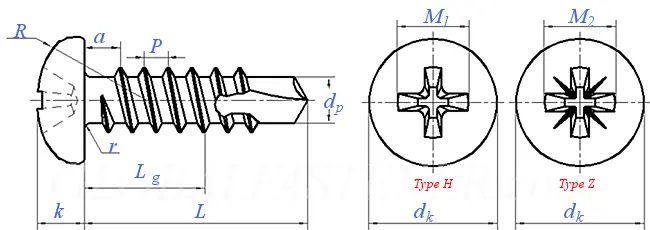
| Thread Size | ST2.9 | ST3.5 | ST4.2 | ST4.8 | ST5.5 | ST6.3 | |
|---|---|---|---|---|---|---|---|
| P | Pitch | 1.1 | 1.3 | 1.4 | 1.6 | 1.8 | 1.8 |
| a | max | 1.1 | 1.3 | 1.4 | 1.6 | 1.8 | 1.8 |
| dk | max | 5.6 | 7 | 8 | 9.5 | 11 | 12 |
| min | 5.3 | 6.64 | 7.64 | 9.14 | 10.57 | 11.57 | |
| k | max | 2.4 | 2.6 | 3.1 | 3.7 | 4 | 4.6 |
| min | 2.15 | 2.35 | 2.8 | 3.4 | 3.7 | 4.3 | |
| r | min | 0.1 | 0.1 | 0.2 | 0.2 | 0.25 | 0.25 |
| R | ≈ | 5.0 | 6.0 | 6.5 | 8.0 | 9.0 | 10.0 |
| dp | 2.3 | 2.8 | 3.6 | 4.1 | 4.8 | 5.8 | |
| Drilling range(thickness) | 0.7~1.9 | 0.7~2.25 | 1.75~3 | 1.75~4.4 | 1.75~5.25 | 2~6 | |
| Socket No. | 1 | 2 | 2 | 2 | 3 | 3 | |
| M1 | 3.0 | 3.9 | 4.4 | 4.9 | 6.4 | 6.9 | |
| M2 | 3.0 | 4.0 | 4.4 | 4.8 | 6.2 | 6.8 | |
Notes for Attention
1. For special countersunk workpieces: The DIN 7504M Countersunk Head Self-Drilling Screw is a special model for 90° countersunk heads and must be used with corresponding angle standard countersunk holes. Installing a flat workpiece without countersunk holes will result in poor fit, raised board surfaces, and failure to achieve seamless assembly.
2. Control drilling speed and pressure: When locking the drill, apply pressure evenly and steadily to avoid sudden and high-speed drilling. Prevent the drill bit from being overloaded and cracking, and local deformation of the board, to ensure the regularity of the hole position and assembly accuracy.
3. Differentiate applicable board thicknesses: Select the corresponding specification screws based on the thickness of the metal board. Short screws will not provide sufficient locking, while long screws may penetrate beyond the limit, affecting the flatness of the assembly and the structural tightness.
4. Do not use under heavy load conditions: This product is suitable for light and medium metal structure fastening. It is not recommended for heavy load-bearing, high-pressure impact core load-bearing points to avoid fatigue fractures due to long-term overload.
5. Standardize tool selection: During construction, use matching specifications of intact wrenches. Worn or deformed tools are prone to causing the slot to slip and rounding, resulting in the screws being locked and difficult to disassemble.
6. Regularly inspect vibration assembly points: For the assembly positions of equipment that undergoes long-term vibration, regular rechecks of the locking status are necessary. Timely fine-tuning and reinforcement are required to prevent small loosening from accumulating and affecting the stability of the equipment.
FAQ
Q1: What are the differences between the core of DIN7504M and DIN7504K self-drilling screws?
The core differences lie in the head structure and installation effect. The 7504K has a round head exposed style, and after installation, the head protrudes from the workpiece, which is only suitable for ordinary basic fixation; the 7504M is a countersunk embedded type, which can be fully embedded in the sheet, achieving a smooth and seamless assembly, suitable for precision, appearance, and interference-free high-standard scenarios.
Q2: Can this DIN 7504M Countersunk Head Self-Drilling Screw be directly drilled into thick stainless steel plates?
Yes, after overall heat treatment and strengthening, the drill tail has high hardness and strong penetration ability. It can be directly drilled into conventional stainless steel plates, aluminum plates, and composite metal plates. The construction will not warp or deform, and no pre-drilling pre-treatment is required in advance.
Q3: Can the countersunk installation achieve complete flatness without protrusions?
As long as it is paired with standard 90° countersunk processing, after installation, the screw head can be completely flush with the surface of the workpiece, without any protrusions, and will not cause friction or interference problems, meeting the requirements of precise and seamless assembly.
Q4: Is the stainless steel material suitable for long-term outdoor use?
The compatibility is good. The stainless steel material has excellent rust prevention and corrosion resistance, can withstand outdoor sunlight, rain, and humid environments, and is not prone to rust and jamming over a long period of use, with stable fastening performance.
Q5: Will there be problems such as slipping or slotting after multiple disassemblies?
This product has thick slots and precise threads. Normal and standard disassembly and adjustment are not prone to slipping or slotting, and can meet the needs of equipment multiple maintenance and fine adjustment, and repeated locking still maintains good meshing accuracy.
Hot Tags: DIN 7504M Self-Drilling Screws, Countersunk Head Self-Drilling Screws Supplier, Self-Drilling Screw Manufacturer
Send Inquiry
Contact Info
-
Address
Comprehensive Bonded Zone,TaizhouPharmaceutical High-tech, China
-
Call
-
Email
Offers excellent, comprehensive customer service every step of the way. Before you order, make real time inquiries through...