Language
- English
- Español
- Português
- русский
- Français
- 日本語
- Deutsch
- tiếng Việt
- Italiano
- Nederlands
- ภาษาไทย
- Polski
- 한국어
- Svenska
- magyar
- Malay
- বাংলা ভাষার
- Dansk
- Suomi
- हिन्दी
- Pilipino
- Türkçe
- Gaeilge
- العربية
- Indonesia
- Norsk
- تمل
- český
- ελληνικά
- український
- Javanese
- فارسی
- தமிழ்
- తెలుగు
- नेपाली
- Burmese
- български
- ລາວ
- Latine
- Қазақша
- Euskal
- Azərbaycan
- Slovenský jazyk
- Македонски
- Lietuvos
- Eesti Keel
- Română
- Slovenski
- मराठी
- Srpski језик

What Makes Stainless Steel T Bolt a Reliable Choice for Modern Fastening?
2026-09-18
Stainless Steel T Bolt is a specialized fastening component designed for applications where a secure connection must be installed inside a slot, channel, rail, or T-shaped groove. Its sliding head allows installers to position the bolt along a profile before tightening, making it particularly useful for aluminum extrusion systems, industrial machinery, solar mounting structures, support channels, equipment frames, and other modular assemblies. Compared with ordinary fastening methods, the T-bolt format can simplify positioning and reduce the need for drilling or access from the rear of a component. Material selection is equally important. 304/A2 stainless steel is commonly used for general indoor and outdoor environments, while 316/A4 stainless steel is more appropriate where moisture, chlorides, marine exposure, or aggressive industrial conditions are present. The correct bolt requires more than simply choosing a diameter: slot compatibility, thread specification, head dimensions, length, strength class, mating nut, installation torque, and environmental conditions should all be considered.
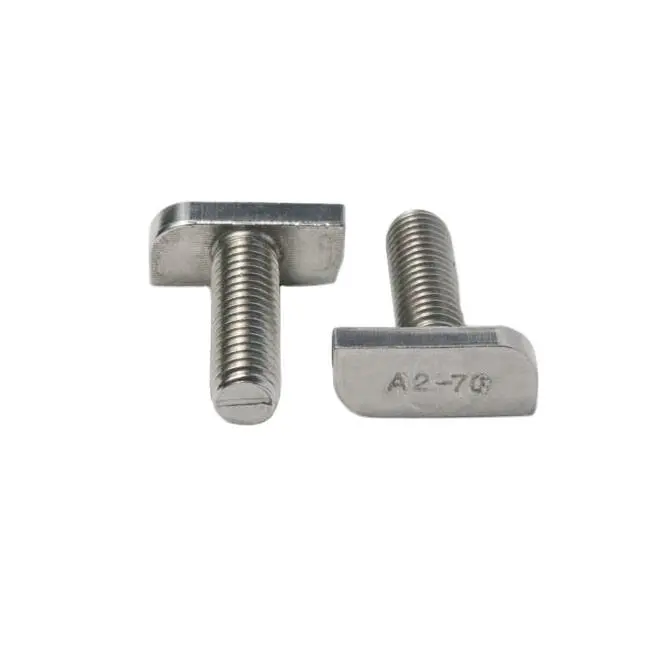
Table of Contents
01. What Is a Stainless Steel T Bolt? 02. How Does the Structure Work? 03. Why Does Stainless Steel Matter? 04. Which Stainless Steel Grades Are Common? 05. Where Are T Bolts Used? 06. What Specifications Matter? 07. How Do T Bolts Compare? 08. How Should They Be Installed? 09. What Problems Should Buyers Avoid? 10. How Can You Select the Right T Bolt? 11. What Defines Manufacturing Quality? 12. FAQ
What Is a Stainless Steel T Bolt?
A Stainless Steel T Bolt is a fastening component designed to work with a compatible slot, channel, extrusion profile, rail, or T-shaped groove. Instead of requiring a conventional bolt hole through the entire assembly, the specially shaped head can be inserted into a slot and moved to the required position before the nut is tightened.
This design is especially useful when components must be adjustable along a mounting track. T bolts are commonly associated with machine T-slots, aluminum extrusion systems, support channels, solar mounting rails, industrial frames, and other modular structures.
The basic assembly normally consists of a T bolt, a compatible nut, and, depending on the system, a washer or spring element. The head remains captured inside the slot while tightening creates the clamping force needed to secure the attached component.
Key idea: The value of a T bolt is not simply its stainless steel material. Its main functional advantage comes from combining corrosion-resistant material with a slot-compatible head design that enables flexible positioning.
How Does the T-Bolt Structure Work?
The T-shaped or hammer-style head is the defining feature. Once inserted into the appropriate slot, the head can travel along the channel until it reaches the desired installation point. When the nut is tightened, the head engages against the internal surfaces of the slot and resists rotation.
01. Slot Entry
The head enters through the designated opening or end of the compatible channel.
02. Positioning
The bolt slides along the channel until it reaches the required mounting location.
03. Clamping
A compatible nut and washer are tightened to clamp the external component.
04. Secure Connection
The captured head and threaded shaft work together to maintain the connection.
This arrangement can be particularly helpful where drilling additional holes would be inconvenient or where components need to be repositioned during assembly. Channel-based fastening systems also support modular construction because the fixing point can be adjusted without redesigning the entire structure.
Why Does Stainless Steel Matter?
Fasteners are often exposed to moisture, condensation, temperature changes, chemicals, outdoor weather, or salt-containing atmospheres. Stainless steel is frequently selected because it provides useful corrosion resistance while maintaining the mechanical function required for fastening.
However, stainless steel should not be treated as a single material with identical performance in every environment. Grade selection matters. For example, 304/A2 stainless steel is commonly specified for general industrial and outdoor applications, while 316/A4 is often selected for marine, coastal, chemical, or chloride-rich environments because of its greater corrosion resistance.
- Corrosion resistance: Helps reduce premature deterioration in humid or outdoor conditions.
- Service life: Properly selected stainless steel can provide long-term fastening performance.
- Appearance: Stainless surfaces are suitable where a clean metallic finish is required.
- Maintenance: Appropriate material selection can reduce corrosion-related maintenance.
- Application flexibility: Stainless T bolts are available for industrial, structural, solar, machinery, and other assemblies.
Environmental exposure, load requirements, mating materials, and installation conditions should always be considered together rather than selecting stainless steel only because the product looks corrosion-resistant.
Which Stainless Steel Grades Are Common?
Several stainless steel grades can be manufactured into T bolts, but 304 and 316 families are among the most commonly specified for general and demanding applications. Some suppliers also provide 316L, 303, 17-4PH, duplex stainless steel, or other alloys for specialized requirements.
| Material | Typical Characteristics | Common Environment |
|---|---|---|
| 304 / A2 | Good corrosion resistance and broad industrial usability | Indoor, general outdoor and standard industrial applications |
| 316 / A4 | Enhanced resistance for more aggressive environments | Coastal, marine, chemical and chloride-rich conditions |
| 316L | Low-carbon stainless steel option for specific requirements | Specialized industrial and corrosion-sensitive applications |
| Special Alloys | Selected according to unusual mechanical or environmental requirements | Specialized engineering applications |
The final choice should be based on the actual service environment and required mechanical properties. A supplier should be able to confirm the specified material grade rather than simply describing a fastener as “stainless steel.”
Where Are Stainless Steel T Bolts Used?
The combination of adjustable positioning and corrosion-resistant stainless steel makes T bolts useful across multiple fastening environments. Their exact suitability depends on the slot geometry, load requirements, material grade, and system design.
Aluminum Extrusion Frames
Used for machine guards, equipment frames, automation structures, workstations, brackets, and modular assemblies.
Solar Mounting Systems
Used with compatible solar rails and clamps where adjustable positioning and outdoor corrosion resistance are required.
Machine Tools
T-slot tables can use T-head bolts for securing fixtures, workpieces, jigs, and accessories.
Support Channels
Channel fastening systems can use T bolts for equipment, piping, cable trays, brackets, and MEP installations.
Construction Systems
Compatible channel systems may use T bolts for structural and architectural installation components.
Marine & Coastal Equipment
316/A4 stainless steel options are commonly considered where salt and chloride exposure creates greater corrosion concerns.
Industrial fastening suppliers document T-bolt use across aluminum profiles, machine tables, solar rails, support channels, construction systems, and other modular structures.
What Specifications Matter When Ordering?
A common purchasing mistake is to provide only “stainless steel T bolt” without defining the actual installation requirements. The product must physically fit the channel and provide the required threaded connection.
| Specification | Why It Matters |
|---|---|
| Material Grade | Determines corrosion resistance and mechanical characteristics. |
| Thread Diameter | Must match the nut, clamp, bracket, or connected component. |
| Thread Length | Must provide sufficient engagement without unnecessary excess. |
| Head Dimensions | Determine whether the T bolt can enter and lock inside the intended slot. |
| Slot Compatibility | Prevents installation problems caused by mismatched profiles or channels. |
| Strength Class | Helps ensure the fastener is appropriate for the required mechanical load. |
| Surface Treatment | May be relevant for appearance, cleanliness, or additional surface requirements. |
| Nut & Washer Matching | Ensures the complete fastening assembly works as intended. |
Common stainless T-bolt offerings include metric thread sizes and different head styles, while custom dimensions can be produced for specific profile or channel systems.
How Do Stainless Steel T Bolts Compare With Conventional Bolts?
T bolts are not intended to replace every conventional bolt. Their main advantage appears when the assembly incorporates a slot, rail, or T-channel and the fastening point needs to be positioned without creating a new through-hole.
| Feature | Stainless Steel T Bolt | Conventional Hex Bolt |
|---|---|---|
| Positioning | Can slide within compatible slots | Normally requires a prepared hole |
| Profile Systems | Designed specifically for compatible slots/channels | Usually requires conventional access |
| Adjustment | Convenient along the slot | Limited by hole location |
| Typical Use | Rails, profiles, channels, machine T-slots | General structural and mechanical fastening |
The right choice therefore depends on the structure rather than simply on the perceived strength of one bolt type. A T bolt is especially valuable when flexible positioning is an important part of the installation process.
How Should Stainless Steel T Bolts Be Installed?
Correct installation starts with compatibility. Before tightening, confirm that the bolt head matches the slot width and internal geometry. A bolt that appears visually similar may still fail to lock correctly if its head dimensions are unsuitable.
- Confirm the profile: Check the exact channel, rail, extrusion, or machine-table specification.
- Check the bolt: Verify material, diameter, thread pitch, head dimensions, and length.
- Insert the head: Place the T head into the appropriate slot or entry point.
- Position the fastener: Slide the bolt to the required mounting location.
- Install the component: Position the bracket, clamp, rail, or other part over the threaded shaft.
- Add washer and nut: Use compatible components where required by the assembly design.
- Tighten correctly: Apply the specified tightening method or torque for the particular assembly.
- Inspect the connection: Check alignment, head engagement, thread engagement, and overall stability.
Installation note: Stainless steel fasteners can be susceptible to thread galling under unsuitable installation conditions. The appropriate nut, lubrication practice, tightening procedure, and material pairing should be considered for demanding assemblies.
For safety-critical, structural, lifting, pressure-containing, or heavily loaded systems, installation requirements should follow the applicable engineering specification rather than relying on generic tightening guidance.
What Common Purchasing Problems Should Buyers Avoid?
Many T-bolt problems occur before the product reaches the installation site. Clear technical communication between the buyer and manufacturer can prevent unnecessary samples, returns, delays, and assembly failures.
Problem 1 — Wrong Slot Size: The head may not enter the channel or may fail to lock securely.
Problem 2 — Wrong Length: An insufficient thread length may prevent adequate engagement, while excessive length can interfere with surrounding components.
Problem 3 — Incorrect Material: Choosing 304 when the environment demands stronger corrosion resistance can shorten service life.
Problem 4 — Incompatible Nut: Thread dimensions and material pairing must be checked as a complete assembly.
Problem 5 — Unclear Drawings: Custom T bolts require accurate head, shaft, thread, and dimensional information.
Problem 6 — Insufficient Inspection: For repeat production, dimensions, threads, material, surface condition, and packaging should be verified according to the agreed requirements.
How Can You Select the Right Stainless Steel T Bolt?
A practical selection process should begin with the installation environment and work backward toward the detailed dimensions.
- Define the application: Identify whether the bolt will be used in machinery, solar mounting, aluminum framing, construction, marine equipment, or another system.
- Measure the slot: Record slot width, channel dimensions, profile series, and entry geometry.
- Select the material: Consider humidity, chemicals, salt exposure, temperature, and maintenance requirements.
- Determine thread size: Match the bolt to the required nut, clamp, bracket, or accessory.
- Calculate useful length: Include the thickness of the connected component, washer, nut, and required thread engagement.
- Confirm mechanical requirements: Consider load, vibration, tightening conditions, and the applicable engineering specification.
- Request samples: For non-standard dimensions, physical samples can help verify compatibility before mass production.
- Confirm inspection requirements: Agree on dimensional inspection, thread checking, material documentation, packaging, and batch identification where needed.
Buyer Checklist
- Stainless steel grade
- Thread diameter and pitch
- Thread length
- Total bolt length
- T-head or hammer-head dimensions
- Compatible slot or channel size
- Required strength class
- Nut and washer specification
- Surface finish or passivation requirement
- Packaging and quantity
- Inspection or certification requirements
What Defines Manufacturing Quality?
A reliable T bolt is more than a piece of stainless steel with a threaded shaft. Dimensional consistency is critical because the head must interact correctly with a specific slot or channel. Thread quality is equally important because the connection depends on predictable engagement between the bolt and nut.
For industrial orders, buyers can consider manufacturers that can provide clear material identification, dimensional control, thread inspection, production traceability, and customized manufacturing based on drawings or samples. Manufacturers in this sector commonly offer different head geometries, thread sizes, lengths, stainless grades, and finishing options for specialized applications.
Taizhou Wanluo Hardware Products Co.,Ltd. can be positioned as a supplier for customers looking for stainless steel fastening components where material selection, dimensional accuracy, application compatibility, and customized requirements are important. For OEM and project-based orders, providing a drawing, sample, channel specification, or detailed dimensional requirements can make product confirmation more efficient.
FAQ About Stainless Steel T Bolts
Are stainless steel T bolts suitable for outdoor use?
Yes, stainless steel T bolts are commonly used in outdoor applications, but the appropriate grade should be selected according to environmental exposure. 304/A2 is widely used for general outdoor conditions, while 316/A4 is often selected for coastal, marine, chloride-rich, or more aggressive environments.
What is the difference between a T bolt and a T-slot bolt?
In many product catalogs, the terms are used for closely related fastening designs. Both generally describe bolts intended to engage with a T-shaped slot or channel. The exact head geometry and compatibility depend on the specific product standard or manufacturer design.
Can stainless steel T bolts be customized?
Yes. Manufacturers may provide custom head dimensions, thread sizes, thread lengths, overall lengths, materials, and other dimensional features according to drawings or samples. Custom T bolts are particularly useful when a standard product does not match the slot geometry.
Which is more corrosion resistant, 304 or 316 stainless steel?
316 stainless steel generally provides greater resistance in chloride-rich and marine environments than 304 stainless steel. The correct choice should still be based on the actual environment, chemical exposure, temperature, and project requirements rather than grade name alone.
Can T bolts be used with aluminum profiles?
Yes. T bolts and hammer-head bolts are widely used with compatible aluminum extrusion profiles. The critical requirement is matching the bolt head dimensions and thread specification to the particular profile system.
Are stainless steel T bolts suitable for solar mounting?
They can be used in compatible solar rail and mounting systems. Stainless steel is often selected for outdoor solar applications because corrosion resistance is an important consideration, while the T-head format allows adjustable positioning along compatible rails.
What information should I provide when requesting a quotation?
Provide the stainless steel grade, thread diameter, thread pitch, total length, thread length, head dimensions, compatible slot or channel dimensions, required quantity, application environment, and any drawing or sample available. This information helps the manufacturer determine the correct product rather than quoting an unsuitable standard item.
Conclusion
A Stainless Steel T Bolt combines the positioning flexibility of a slot-based fastening system with the corrosion resistance and durability associated with stainless steel. Its practical value is especially clear in applications where components need to be positioned along rails, channels, machine tables, or aluminum profiles without creating additional mounting holes.
Choosing the correct product requires more than selecting a diameter. Buyers should evaluate stainless steel grade, head geometry, slot compatibility, thread dimensions, length, mechanical requirements, installation conditions, and the complete nut-and-washer assembly. When these factors are properly matched, T bolts can provide a clean, adjustable, and dependable fastening solution for industrial equipment, modular frames, solar mounting systems, construction installations, and specialized assemblies.
Need Stainless Steel T Bolts for Your Project?
Whether you need standard sizes, custom dimensions, specific stainless steel grades, or OEM fastening solutions, Taizhou Wanluo Hardware Products Co.,Ltd. can help you evaluate the appropriate specifications for your application.
Contact us with your drawing, sample, slot dimensions, material requirements, or project specifications to discuss the right Stainless Steel T Bolt solution.
Related News
- Can automated‑assembly disruptions stem from GB818 Pan Head Cross Recessed Machine Screw batch variations?
- How Does a Hex Socket Combination Screw Improve Fastening Performance?
- What procurement mistakes cause Stainless Steel Wire Rope project failures?
- Do surface‑perfect samples mask Conical Cap Expansion Bolt field‑project risks?
- What Makes a Hex Flange Concrete Anchor Bolt Reliable for Heavy-Duty Construction?